On the morning of September 25, a cutting-edge academic report in the field of Environmental Science was successfully held in Conference Room 221 of the Resources and Environment Building of our university. Invited as the keynote speaker for this report,Associate Professor Wu Libin, Deputy Director of the Department of Geography, School of Earth System Science, Tianjin University, focused on the themeFrom the Xisha Islands to Antarctica: The Impacts of Seabird-mediated Biological Transport on the Ecological Environment. By comparing typical subtropical and polar ecosystems, he systematically elaborated the ecological cascade effects of seabirds as"biological transport vectors".
Based on the long-term tracking data from his research team’s scientific expeditions in China’s Xisha Islands and Antarctica, Associate Professor Wu Libin put forward the conclusion: typical seabird populations represented by red-footed boobies form nutrient transport corridors through transoceanic migration — they enrich phosphorus, nitrogen and other nutrients from the ocean onto islands in the form of excreta, which greatly improves soil fertility, and drives the succession of vegetation communities as well as the formation of endemic biodiversity hotspots. In the Antarctic region, however, seabird communities transport marine mercury pollutants to the land through fish predation, resulting in mercury concentrations in sediments of penguin habitats being several times higher than those in surrounding areas.
This"marine-terrestrial biological pump"mechanism is dual-natured: seabirds act as ecological engineers on oligotrophic islands, yet become potential environmental risk sources in the diffusion of pollutants.
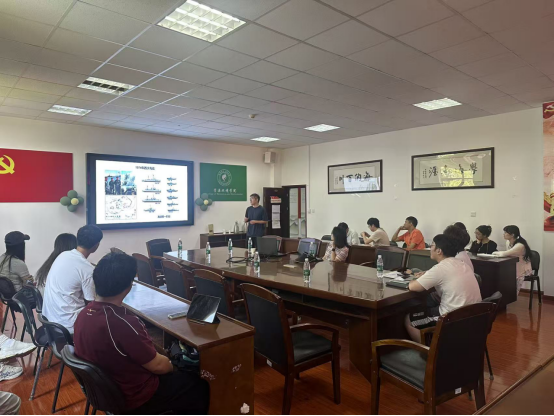
The research further quantified the transport efficiency: seabird populations in the Xisha Islands input more than several tons of nitrogen into the land each year, equivalent to the formation of a near-natural"ecological fertilization system". In Antarctic research stations, various seabird species led by Antarctic polar penguins contribute to the vast majority of terrestrial loads of emerging pollutants via biological transport. Professor Wu emphasized that against the backdrop of climate change, it is imperative to construct a"Seabird Ecological Function Assessment System": we should not only protect key breeding grounds to sustain positive ecological services, but also block the amplification of toxic substances through food chains via pollutant source tracing and regulation. He also expressed the vision of deepening cooperation with our university in the interdisciplinary research field of marine-terrestrial ecology.
The report sparked in-depth interactions on site. In response to questions such as satellite tracking verification in seabird migration path modeling and the indirect impacts of biological transport on coral reef carbon cycles, Professor Wu provided professional interpretations by combining case studies of bird banding tracking heat maps and isotopic source apportionment. Faculty, students and guests in the field of environmental engineering conducted disciplinary discussions focusing on research directions including"biological indication of cross-border migration of polar pollutants"and"biomimetic strategies for island ecological restoration". Initial discussions were held on cooperation approaches such as joint application for research projects on polar biogeochemical cycles and co-construction of a marine-terrestrial ecological security monitoring network. This forum has injected new impetus into deepening inter-university collaborative innovation in cutting-edge fields such as blue carbon sinks and ecological responses to global change.